


- Posted on
- By Harmonyrecipes
- In Beef Recipes
- Leave a comment

The Ultimate Prime Rib Roast Recipe: A Show-Stopping Holiday Masterpiece
Picture this: your dining room filled with family and friends, their eyes widening as you carry in a magnificent prime rib roast, its caramelized crust gleaming, aromatic steam rising into the air. You carved out time from your hectic schedule, pushed past your doubts, and now you’re about to serve something extraordinary. This moment—this exact feeling—is what cooking prime rib is truly about.
Maybe you’ve watched cooking shows where chefs make it look effortless, or perhaps you’ve tasted an unforgettable prime rib at a steakhouse and thought, “I could never recreate that.” Here’s what nobody tells you: preparing a restaurant-quality prime rib roast at home isn’t nearly as complicated as it seems. What separates success from disappointment isn’t culinary school training or years of experience—it’s understanding a few fundamental principles and having the confidence to trust your process.
Your grandmother might have made it look easy, but she probably felt nervous her first time too. Every accomplished home cook started exactly where you are now: staring at a recipe, wondering if they’d mess up an expensive cut of meat, hoping everything would turn out right. This guide will walk you through every decision, every technique, and every timing consideration you need to nail your prime rib roast on the first attempt.
Table of Contents
What Makes Prime Rib Roast Recipe the King of Holiday Meats
When you walk into a high-end steakhouse, prime rib commands the highest price on the menu for good reason. This cut comes from the primal rib section of the cow—specifically ribs six through twelve—where the meat develops exceptional marbling and tenderness. Unlike cheaper cuts that require slow braising or careful preparation to avoid toughness, prime rib naturally delivers buttery texture and rich flavor.
The USDA grades beef based on marbling, and “Prime” represents the top two percent of all beef produced. You’ll notice intricate white fat streaks running through quality prime rib, which melt during cooking and baste the meat from within. This internal moisture system is what creates that melt-in-your-mouth quality you remember from expensive restaurants.
Standing rib roast and prime rib refer to the same cut, though technically “prime rib” should only describe USDA Prime grade beef. Most home cooks purchase Choice grade, which costs substantially less but still delivers outstanding results. The bone-in version provides extra flavor and makes a dramatic presentation, while boneless versions carve more easily but sacrifice some richness.
Nutritionally, you’re looking at a protein-dense food rich in iron, zinc, and B vitamins. A four-ounce serving contains approximately 310 calories with 24 grams of protein. Yes, it’s indulgent, but special occasions call for special meals.
Choosing the Perfect Prime Rib Roast Recipe
Understanding Cuts and Grades
Walking up to the butcher counter shouldn’t feel intimidating. Start by deciding between bone-in and boneless. Bones act as natural heat shields, allowing the meat closest to them to cook more gently. This creates a gradient of doneness within a single roast—your guests who prefer medium-well can enjoy the outer portions while those craving medium-rare get the center slices. Boneless roasts cook more uniformly and carve effortlessly, but you miss out on those phenomenal rib bones that make incredible leftovers.
The “first cut” comes from ribs ten through twelve, closer to the loin. This section features a larger eye of meat with less fat. The “second cut” (ribs six through nine) sits closer to the chuck and contains more marbling and fat, translating to deeper flavor but slightly less tenderness. For most home cooks, the first cut provides the best balance.
USDA Prime beef costs roughly 30-40% more than Choice, but the difference in marbling is noticeable. Choice grade still produces excellent prime rib roast—you’re not settling for inferior quality, just making a practical decision that frees up your budget for sides and wine.
Plan on purchasing three-quarters to one full pound per person for bone-in roasts. That seven-pound roast you’re eyeing will feed six to eight guests comfortably, with maybe enough leftovers for sandwiches the next day.
What to Look for at the Butcher
Your eyes should immediately check the marbling. Those white streaks should be evenly distributed throughout the meat, not concentrated in pockets. The exterior fat cap should measure at least a quarter-inch thick—this layer protects the roast during high-heat cooking and contributes tremendous flavor.
Fresh prime rib displays a bright cherry-red color. Any grayish or brown tones suggest oxidation, meaning it’s been sitting too long. The surface should appear slightly moist but never slimy or sticky. If you’re purchasing bone-in, the bones should look white or cream-colored, not dark or dried out.
Don’t hesitate to ask your butcher questions:
- When did this arrive?
- Is this Choice or Prime grade?
- Can you trim it to my preferences?
- Will you tie it if I purchase boneless?
Quality butchers appreciate customers who care about their ingredients and will guide you toward the best available options.
Essential Ingredients for Prime Rib Roast
Simplicity defines exceptional prime rib. You’re showcasing premium beef, not masking it under complex spice blends. Here’s exactly what you need:
Ingredient | Quantity | Purpose |
|---|---|---|
Prime rib roast (bone-in) | 5-7 lbs (3-4 ribs) | Main protein |
Kosher salt | 2-3 tablespoons | Seasoning & crust formation |
Black pepper (freshly ground) | 1-2 tablespoons | Flavor enhancement |
Fresh garlic cloves | 6-8 cloves, minced | Aromatic base |
Fresh rosemary | 3-4 sprigs (2 tbsp chopped) | Herbal notes |
Fresh thyme | 4-5 sprigs (1 tbsp chopped) | Complementary herb |
Olive oil or butter | ¼ cup | Coating & moisture |
Dijon mustard (optional) | 2 tablespoons | Flavor & herb adhesion |
Notice what’s missing from this table? Complicated marinades, exotic spices, or unnecessary additions. When you’re working with premium beef, restraint shows confidence.
Fresh herbs make a noticeable difference over dried versions. The oils in fresh rosemary and thyme release during cooking, creating an aromatic crust that dried herbs simply cannot match. Kosher salt’s larger crystals distribute more evenly than table salt, and freshly cracked black pepper delivers sharper flavor than pre-ground powder
Step-by-Step Prime Rib Roast Recipe
Preparation Phase (24-48 Hours Before Cooking)
The single most important step happens days before your guests arrive: dry brining. Remove your prime rib roast from its packaging and pat it completely dry with paper towels. Generously season every surface with kosher salt—approximately one tablespoon per five pounds of meat. Don’t be timid here; most of this salt will create the crust, not penetrate the meat’s interior.
Place your salted roast uncovered on a wire rack set over a baking sheet, then refrigerate for 24 to 48 hours. This accomplishes three critical goals: the salt draws out surface moisture which then reabsorbs carrying salt into the outer layers, the exposed surface dries out which promotes better browning, and the meat’s enzymes naturally tenderize the muscle fibers.
Three hours before cooking, remove your prime rib from the refrigerator. Cold meat entering a hot oven cooks unevenly—the exterior overcooks while the center remains cool. Room temperature meat (around 65-70°F) roasts uniformly, giving you that perfect edge-to-edge doneness photographers capture in magazine spreads.
Seasoning Your Prime Rib Roast
Mix your minced garlic, chopped rosemary, chopped thyme, and olive oil into a thick paste. Some cooks add Dijon mustard to this mixture, which helps herbs adhere while contributing subtle tanginess. Smear this herb paste over every inch of your roast, pressing it firmly so it sticks during cooking.
If you’re feeling adventurous, create small slits in the fat cap and tuck whole garlic cloves and herb sprigs directly into the meat. These aromatic bombs release their flavors throughout the roast rather than just seasoning the surface.
The Traditional Oven Method
Position your oven rack in the lower-middle position and preheat to 450°F. You need genuine high heat, not an approximation—use an oven thermometer if your oven runs cool. Place your seasoned prime rib roast bone-side down (or fat-cap up if boneless) on a roasting rack inside a heavy pan. The rack elevates the meat, allowing hot air to circulate underneath for even cooking.
Slide your pan into the oven and roast at 450°F for fifteen to twenty minutes. This initial blast creates the deeply browned, herb-crusted exterior that makes prime rib visually stunning. You’ll hear sizzling and might notice your kitchen filling with smoke—that’s normal. Turn on your exhaust fan but resist the urge to lower the temperature prematurely.
After this high-heat sear, reduce your oven to 325°F without opening the door. Now comes the slow roasting phase where patience pays off. Your prime rib will continue cooking gently, the internal temperature rising steadily while the exterior remains protected by that beautiful crust you just created.
Insert a probe thermometer into the thickest part of the roast, making sure it doesn’t touch bone. You’re targeting these internal temperatures:
- Rare: 120-125°F (cool red center)
- Medium-rare: 130-135°F (warm red center)
- Medium: 135-145°F (pink center)
- Medium-well: 145-155°F (slightly pink)
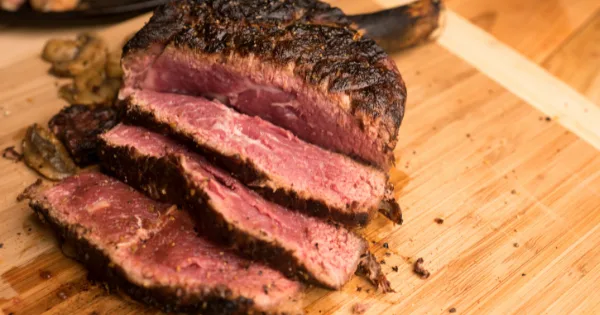
For most people, medium-rare delivers the optimal balance of tenderness and flavor. The meat slices beautifully, juices flow freely, and you’ll hear genuine appreciation from your guests.
Timing Guide for Prime Rib Roast
Approximate cooking times provide rough guidelines, but your thermometer tells the truth:
Roast Size | Rare (120-125°F) | Medium-Rare (130-135°F) | Medium (140-145°F) |
|---|---|---|---|
3-4 lbs | 1.5-2 hours | 2-2.5 hours | 2.5-3 hours |
5-6 lbs | 2-2.5 hours | 2.5-3 hours | 3-3.5 hours |
7-8 lbs | 2.5-3 hours | 3-3.5 hours | 3.5-4 hours |
Remember: these times include the initial high-heat sear. Larger roasts require longer cooking but develop more pronounced flavor gradients. Smaller roasts cook faster but leave less margin for error.
Resting and Carving Your Prime Rib Roast
When your thermometer reads five degrees below your target temperature, remove the roast from the oven. Carryover cooking will continue raising the internal temperature another five to ten degrees during the resting period. This phenomenon happens because the exterior remains much hotter than the interior—heat continues migrating toward the center even after leaving the oven.
Tent your prime rib loosely with aluminum foil and let it rest for twenty to thirty minutes minimum. Cutting immediately causes all those precious juices to spill across your cutting board instead of staying inside the meat. During resting, moisture redistributes throughout the roast, ensuring every slice is juicy rather than just the center.
When you’re ready to carve, remove the bones if present by running a long knife along the contour where meat meets bone. Slice the boneless section into half-inch to three-quarter-inch steaks, cutting perpendicular to the grain. Thinner slices look elegant and stretch your roast further; thicker slices deliver that steakhouse experience.
Arrange your slices on a warmed platter, slightly overlapping them to display that perfect pink interior. Those bones you removed? Cut them into individual ribs for guests who want to gnaw on something spectacular.
Classic Prime Rib Roast Accompaniments
Your prime rib deserves supporting players that complement without competing. Traditional options exist for good reason—they work.
Horseradish sauce cuts through richness with sharp, nose-clearing intensity. Mix prepared horseradish with sour cream, a squeeze of lemon, and a pinch of salt. The proportions depend on how much heat you enjoy.
Au jus elevates every bite when made properly. Pour off excess fat from your roasting pan, leaving browned bits stuck to the bottom. Add beef stock and a splash of red wine, then scrape up those crusty deposits while simmering. Strain and serve alongside your sliced meat.
Yorkshire pudding requires pan drippings, eggs, flour, and milk whipped into a batter then baked in a screaming-hot oven. These golden, puffy creations soak up au jus beautifully.
Roasted vegetables, creamed spinach, and loaded baked potatoes round out your menu without demanding last-minute attention. Prepare sides that can hold in a warm oven while you focus on timing your prime rib perfectly.
Common Prime Rib Roast Mistakes to Avoid
Learning from others’ errors saves you from costly disappointments:
- Skipping the meat thermometer – Guessing doneness by time alone guarantees inconsistent results
- Cooking from refrigerator temperature – Creates a gray outer ring of overcooked meat
- Cutting too early – Juice loss turns your roast disappointingly dry
- Excessive seasoning – Prime beef speaks for itself; don’t drown it in spices
- Opening the oven repeatedly – Every peek drops temperature and extends cooking time
- Improper resting – Rushing this step wastes all your careful preparation
- Wrong initial temperature – Low starting heat produces gray, steamed meat instead of a caramelized crust
Storing and Reheating Leftover Prime Rib Roast
If you’re fortunate enough to have leftovers, wrap them tightly in plastic wrap or aluminum foil and refrigerate within two hours of serving. Properly stored prime rib lasts three to four days.
For reheating, low and slow preserves tenderness. Place slices in a baking dish with a few tablespoons of beef broth, cover tightly with foil, and warm in a 250°F oven until heated through. This gentle approach prevents the meat from toughening or drying out.
Avoid microwaving if possible—the uneven, aggressive heating ruins texture and flavor. If you must use a microwave, do so at fifty percent power in thirty-second intervals, checking frequently.
Frequently Asked Questions About Prime Rib Roast
What’s the difference between prime rib and ribeye?
Prime rib is the full roast cut from the rib section, while ribeye refers to individual steaks sliced from that same area. Prime rib roast is typically bone-in and cooked whole, whereas ribeye comes boneless and cooks as single portions
How do I know when my prime rib roast is done?
Insert a meat thermometer into the thickest section, avoiding any bone. For medium-rare prime rib, remove from the oven when the internal temperature reaches 130-135°F. The temperature will continue rising during the resting period.
Can I prepare prime rib roast ahead of time?
Absolutely. Season your prime rib roast one to two days early and refrigerate uncovered. This dry-brining method enhances flavor while creating better crust formation. Bring it to room temperature two to three hours before cooking for even results.
Why is my prime rib roast tough?
Overcooking causes toughness. Prime rib should reach medium-rare or medium at most for optimal tenderness. Using a reliable meat thermometer and respecting the resting period prevents this common problem.
Do I need to tie my prime rib roast?
Boneless prime rib roast benefits from tying to maintain uniform shape and promote even cooking. Bone-in roasts typically don’t require tying, though some cooks temporarily remove the bones and tie them back on for easier carving later.
How much prime rib roast per person should I buy?
Purchase three-quarters to one pound per guest for bone-in prime rib roast, or half to three-quarters pound per person for boneless. This accounts for bone weight and natural shrinkage during cooking while allowing modest seconds.
Should I sear my prime rib roast before or after roasting?
Both techniques work beautifully. The traditional method starts with high heat then reduces temperature for gentle roasting. The reverse sear slow-cooks first then finishes with a blistering sear. Both produce outstanding prime rib roast results.
Your Prime Rib Roast Journey Begins Here
You’ve reached the end of this guide, but your real journey starts when you pull that roast from the butcher case, bring it home, and commit to creating something memorable. That nervous energy you feel? Channel it into careful preparation rather than letting it become hesitation.
Your first prime rib roast might not match magazine perfection—few do. What matters is the pride you’ll feel sliding it from the oven, the confidence gained from tackling something ambitious, and the memories created around your dinner table. Even professional chefs overcook meat sometimes or misjudge timing. The difference between them and uncertain home cooks isn’t superhuman skill—it’s willingness to try again.
This recipe isn’t complicated, despite its impressive reputation. You’re essentially seasoning meat, roasting it at two temperatures, checking with a thermometer, and resting before carving. Follow these principles, trust your preparation, and remember that your guests gather to celebrate with you, not critique your cooking.
So take that deep breath, confirm your thermometer works, and prepare to amaze everyone at your table. Your prime rib roast doesn’t need perfection to create joy—it just needs your attention and care.
Ready to master your holiday menu? Share your prime rib success stories in the comments below, and subscribe for weekly recipes that transform home cooks into confident kitchen leaders. Your next show-stopping meal awaits.



No comment yet, add your voice below!